
Table of Contents
In the global financial landscape of 2026, real estate remains the cornerstone of wealth creation. As India’s economy continues its trajectory toward the $5 trillion milestone, the question for investors has evolved. It is no longer just about buying property it is about choosing the right asset class to match a specific financial outcome.
The choice between Commercial and Residential real estate involves a trade-off between stability and yield. This guide provides a comprehensive, data-driven analysis of both sectors to help you navigate the complexities of the current market.
1. Defining Commercial vs Residential Real Estate in the 2026 Context
To make an informed decision, one must first understand how these sectors have transformed over the last few years.
Residential Real Estate (The Lifestyle Asset)
Residential property serves the primary human need for shelter. In today’s market, this category has split into two distinct paths:
- End-User Driven: Properties bought for personal use, where the value is derived from comfort and location.
- Investment Driven: Properties bought for capital appreciation, focusing on high-growth corridors like the Dwarka Expressway or Sohna Road.
Commercial Real Estate (The Performance Asset)
Commercial property is a business-centric investment. Its value is directly tied to economic activity and corporate expansion.
- Office Spaces: Driven by the massive influx of Global Capability Centres (GCCs).
- Retail & High-Street: Fueled by rising domestic consumption and brand expansions.
- Warehousing: Growing due to the logistics and e-commerce boom.
2. Head-to-Head Comparison: Commercial vs Residential
/
| Investment Metric | Residential Real Estate | Commercial Real Estate |
| Gross Rental Yield | 2.5% – 4% | 7% – 11% |
| Annual Appreciation | 8% – 15% (Infra-dependent) | 5% – 9% (Occupancy-dependent) |
| Lease Structure | 11 months – 2 years | 3 years – 15 years |
| Maintenance | Usually Landlord-led | Often Tenant-led (Triple Net) |
| Financing (LTV) | Up to 80-90% | Typically 50-60% |
| Tax Benefits | Significant (Sec 24, 80C) | Standard Business Deductions |
3. Commercial Real Estate: The Engine for Cash Flow
For investors prioritizing immediate and high-volume cash flow, the commercial sector is the primary choice.
The Advantages
- High Rental Yields: In prime business districts, commercial properties consistently outpace residential yields by 2x to 3x.
- The Rise of SM REITs: Small and Medium Real Estate Investment Trusts have democratized the sector. Investors can now gain exposure to Grade-A commercial assets with smaller capital outlays, enjoying professional management and high transparency.
- Lease Stability: Unlike residential tenants who may move frequently, corporate tenants often sign multi-year leases and invest significantly in “fit-outs,” ensuring they stay for the long term.
The Risks
- Economic Sensitivity: Commercial real estate is a “lagging indicator.” If the global economy faces a slowdown, corporate leasing is often the first area to see a pause.
- Entry Barriers: Commercial assets typically require higher ticket sizes and more rigorous legal due diligence compared to buying a standard apartment.
4. Residential Real Estate: The Anchor of Security
Residential property remains the most resilient asset class in the Indian market, serving as a “safe haven” during periods of volatility.
The Advantages
- Capital Appreciation: While rental yields are lower, the “Premiumization” trend has led to massive capital gains. In high-demand hubs, property values have seen double-digit growth, often outperforming the stock market over a 5-year horizon.
- Ease of Financing: Banks are far more willing to lend for residential purchases. Home loans are accessible, and the interest rates are generally lower than commercial mortgage rates.
- Liquidity: The secondary market for residential properties is vast. Finding a buyer for a well-located 3BHK is traditionally faster than finding a buyer for a large-scale warehouse or office block.
The Risks
- Economic Sensitivity: Commercial real estate is a “lagging indicator.” If the global economy faces a slowdown, corporate leasing is often the first area to see a pause.
- Entry Barriers: Commercial assets typically require higher ticket sizes and more rigorous legal due diligence compared to buying a standard apartment.
5. 2025-2026 Market Trends: What Investors Are Watching
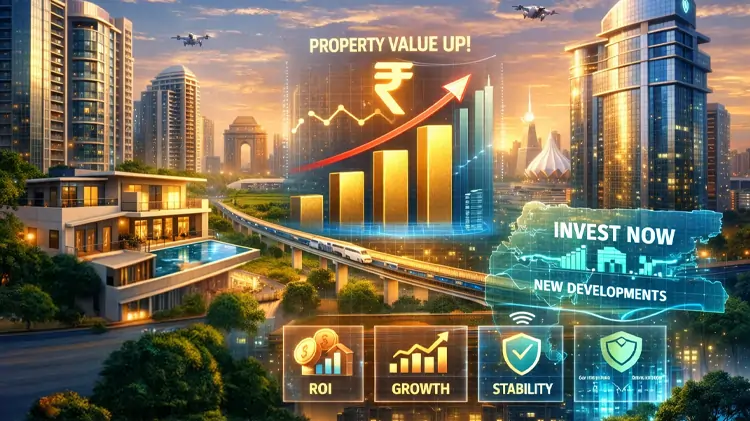
- The Multi-Modal Effect: Areas near new expressways and metro extensions are seeing the highest “Price Velocity.”
- Sustainability Standards: Large-scale developers are now prioritizing IGBC (Indian Green Building Council) certifications. These “Green Buildings” command higher rents and better resale values as tenants and buyers become more eco-conscious.
- The Digital Shift: The 2026 market is characterized by transparency. Digital land records and RERA-strict timelines have reduced the “trust deficit” that previously plagued the industry.
Real estate is no longer just about location; it is about Connectivity and Infrastructure.
The Industry Perspective: A Professional Strategy
At Ganga Realty, the philosophy shared with seasoned investors is one of Balanced Growth. In the current economic climate, a one-size-fits-all approach is rarely successful.
A sophisticated portfolio often adheres to a “hybrid” model:
- 70% Residential Allocation: To capture capital growth and provide a safety net for the family.
- 30% Commercial Allocation: To generate the liquidity needed to pay off EMIs or fund lifestyle requirements.
As the market matures, the focus is shifting toward Sohna (South Gurugram) and the peripheral sectors of the Dwarka Expressway. These regions represent the “Infrastructure-led growth” that both residential and commercial investors are currently targeting.
7. Final Verdict: Matching Your Goals
- Choose Residential if: You are a first-time buyer, looking for tax benefits, or prioritizing long-term capital gains over monthly cash flow.
- Choose Commercial if: You are an experienced investor with surplus capital looking for high-yield passive income and professional tenant relationships.
Real estate is a long-term game. In 2026, the winners are those who move away from speculation and toward data-driven, strategic acquisitions.
If you are ready to start your investment journey in 2025 and build a high-growth portfolio for 2026 and beyond, [Contact Us] today for expert guidance at Ganga Realty.
Frequently Asked Questions (FAQs)
Is it better to buy a shop or a flat for investment in 2026?
If you need high monthly rent, a shop (Commercial) is better. If you want a property that is easy to sell and offers high resale value, a flat (Residential) is usually safer.
What are GCCs and how do they affect me?
Global Capability Centres are offices set up by MNCs in India. Their rapid growth is the main reason commercial office space is currently a high-performing investment.
Does the $5 trillion economy goal impact my property value?
Yes. Economic growth leads to infrastructure spending, which in turn leads to higher demand for both housing and office spaces.
What is the role of RERA in 2026?
RERA has ensured that developers are accountable for timelines. It has made “Under-Construction” projects a viable and safe option for investors again.